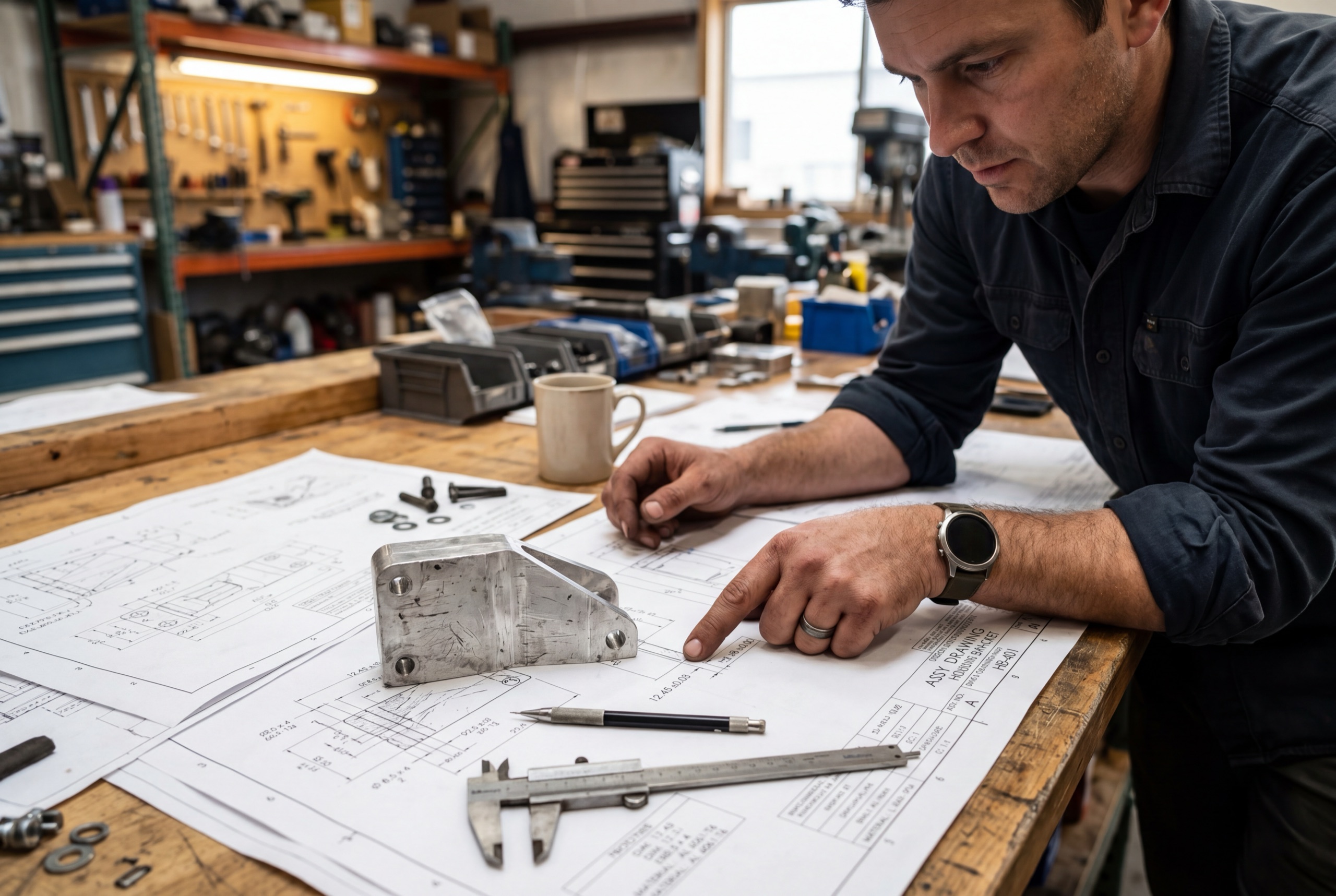
What Is Design for Manufacturing (DFM)?
Design for Manufacturing (DFM) is an engineering approach that optimizes product designs to make them easier, more reliable, and more cost-effective to manufacture. Rather than designing a product in isolation and then figuring out how to build it, DFM integrates manufacturing considerations into the design process from day one.
The goal is simple: create products that perform as intended while minimizing manufacturing complexity, reducing material waste, and shortening production timelines.
Why DFM Matters
Studies consistently show that 70-80% of a product's manufacturing cost is determined during the design phase. Once a design is finalized, opportunities for cost reduction become limited. DFM addresses this by identifying potential manufacturing challenges early, when changes are inexpensive and easy to implement.
Common Problems DFM Prevents
Unnecessarily Tight Tolerances: Designers sometimes specify tighter tolerances than functionally necessary, which dramatically increases machining time and cost.
Difficult-to-Manufacture Features: Internal corners with sharp radii, deep narrow pockets, and thin-walled sections can be extremely challenging and expensive to produce.
Material Selection Issues: Choosing materials based solely on performance without considering machinability, availability, and cost can lead to production delays and budget overruns.
Assembly Complications: Products designed without considering the assembly sequence may require excessive fixturing, specialized tools, or time-consuming manual operations.
Core DFM Principles
1. Simplify the Design
Reduce the number of parts wherever possible. Fewer parts mean fewer operations, fewer potential failure points, and lower assembly costs. Consider combining multiple components into a single part through creative design.
2. Standardize Components
Use standard hardware, fasteners, and off-the-shelf components whenever possible. Custom components are more expensive and have longer lead times. Standardization also simplifies inventory management and replacement part sourcing.
3. Design for the Manufacturing Process
Understand the capabilities and limitations of your chosen manufacturing processes. If your product will be CNC machined, design features that are compatible with standard tooling. If it will be sheet metal, design for standard bend radii and avoid features that require secondary operations.
4. Minimize Material Waste
Design parts to nest efficiently on standard material sizes. Consider how raw material will be cut, formed, or machined, and optimize your design to minimize scrap.
5. Consider Assembly Sequence
Design products that can be assembled in a logical, efficient sequence. Use self-locating features, minimize the number of fastener types, and ensure components can be accessed easily during assembly.
The DFM Process at AAI
At Automated Assembly Inc., our DFM process follows a structured approach:
Step 1: BOM Validation, We review your Bill of Materials to identify opportunities for standardization, cost reduction, and improved availability.
Step 2: Manufacturability Analysis, Our engineers evaluate each component for manufacturing feasibility, identifying potential issues with tolerances, materials, or processes.
Step 3: Cost Optimization, We provide recommendations to reduce manufacturing costs without compromising product performance or quality.
Step 4: Design Iteration, Working collaboratively with your engineering team, we refine the design until it's optimized for production.
DFM Case Study: Reducing Costs by 35%
A hardware startup approached us with a product design that required 47 unique components, including several custom machined parts with unnecessarily tight tolerances. Through our DFM process, we:
- Consolidated 47 components down to 31 by combining parts and using multi-function designs
- Relaxed tolerances on non-critical dimensions, reducing machining time by 40%
- Replaced three custom fasteners with standard alternatives
- Redesigned two sheet metal components to eliminate secondary bending operations
The result: 35% reduction in per-unit manufacturing cost and a 3-week shorter production timeline.
When to Engage DFM
The earlier you engage DFM, the greater the potential savings. Ideally, DFM should begin during the concept design phase and continue through detailed design and prototyping. However, even products already in production can benefit from DFM analysis to reduce costs for future production runs.
Get Expert DFM Support
At Automated Assembly Inc., our engineering team provides comprehensive DFM services as part of our contract manufacturing process. Whether you're developing a new product or looking to optimize an existing design, we can help you reduce costs and improve manufacturability.
Contact us for a free DFM consultation and discover how we can optimize your product for production.