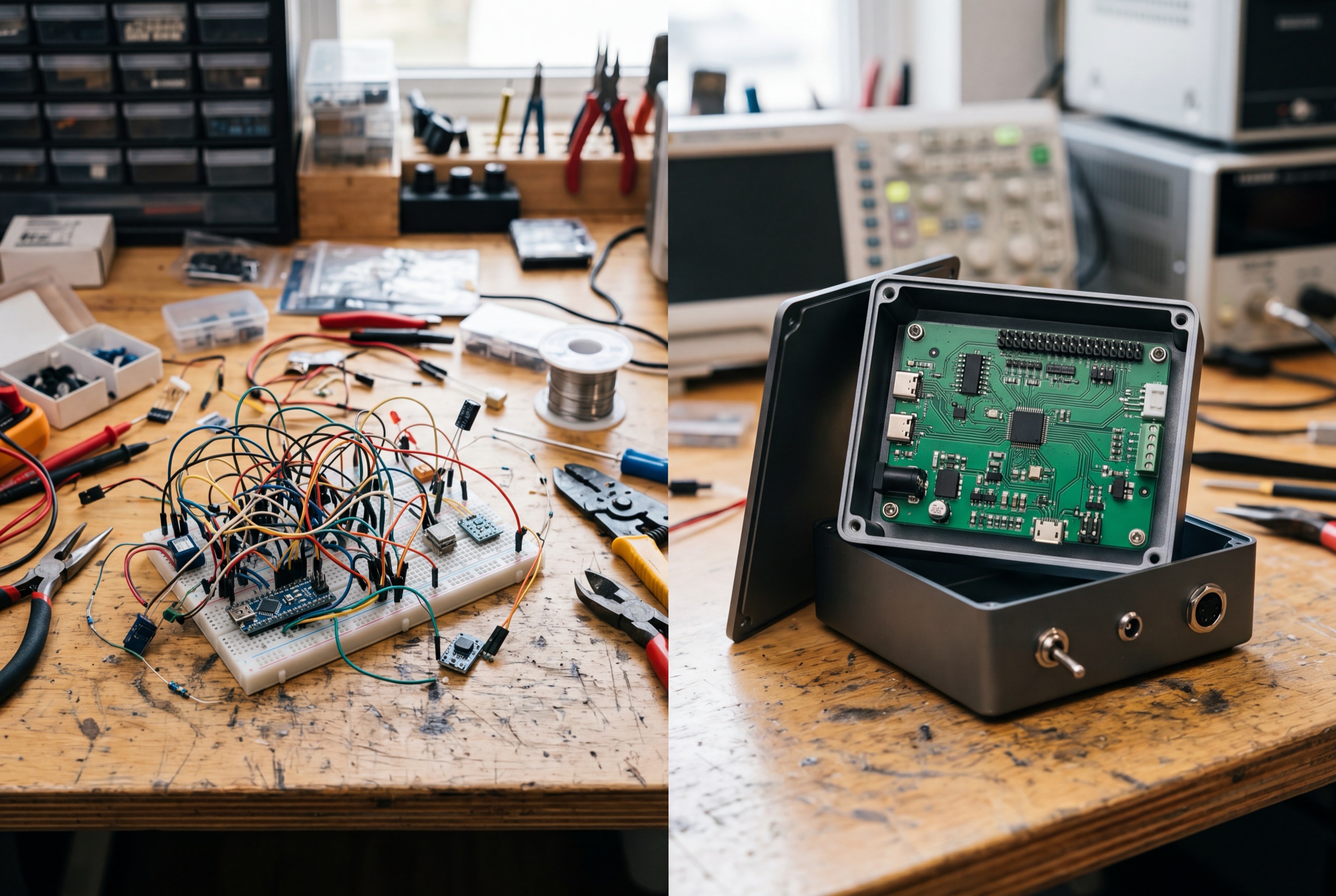
The Prototype-to-Production Journey
Every manufactured product begins as an idea. Transforming that idea into a market-ready product requires a systematic approach that balances speed, quality, and cost. This guide outlines the complete journey from initial prototype to full-scale production.
Phase 1: Proof of Concept (POC)
The first prototype is about answering a fundamental question: does this concept work?
What to Expect: POC prototypes are typically rough, functional models that validate core principles. They may be 3D printed, hand-assembled, or built from off-the-shelf components. The focus is on function, not form.
Key Activities:
- Validate core functionality and performance
- Identify major design challenges early
- Test critical assumptions about materials and mechanisms
- Gather initial feedback from stakeholders
Timeline: 1-4 weeks depending on complexity
Phase 2: Engineering Prototype
Once the concept is validated, the engineering prototype refines the design for real-world performance.
What to Expect: Engineering prototypes use production-intent materials and processes. They look and function much closer to the final product, though they may still be hand-assembled.
Key Activities:
- Refine mechanical and electrical design
- Conduct DFM (Design for Manufacturing) analysis
- Validate BOM (Bill of Materials) and sourcing
- Perform initial environmental and stress testing
- Iterate based on test results
Timeline: 2-6 weeks per iteration
Phase 3: Pre-Production Prototype
The pre-production prototype is built using actual production processes and tooling.
What to Expect: These prototypes should be indistinguishable from production units. They validate that the manufacturing process produces consistent, quality results.
Key Activities:
- Build units using production tooling and processes
- Validate assembly procedures and work instructions
- Conduct full functional and load testing
- Obtain regulatory certifications if required
- Finalize packaging and labeling
Timeline: 3-6 weeks
Phase 4: Pilot Production Run
Before committing to full-scale production, a pilot run validates the entire manufacturing process at a small scale.
What to Expect: A pilot run typically produces 10-50 units using the full production process. This identifies any remaining issues with tooling, fixtures, assembly sequence, or quality control.
Key Activities:
- Produce a small batch using full production process
- Measure cycle times and identify bottlenecks
- Validate quality control procedures
- Train production staff on assembly procedures
- Conduct final design review and sign-off
Timeline: 2-4 weeks
Phase 5: Full-Scale Production
With all processes validated, full-scale production begins.
What to Expect: Consistent, repeatable production at your target volumes. Your contract manufacturer should provide regular quality reports, production updates, and continuous improvement recommendations.
Key Activities:
- Ramp up to target production volumes
- Implement ongoing quality monitoring
- Optimize production efficiency
- Manage supply chain and inventory
- Provide regular production reports
Common Pitfalls to Avoid
Skipping the DFM Phase: Rushing from prototype to production without DFM analysis almost always results in higher costs and longer timelines.
Underestimating Tooling Lead Times: Custom tooling and fixtures can take 4-8 weeks to design and build. Plan accordingly.
Ignoring Supply Chain Risks: Ensure critical components have reliable supply chains with backup sources identified.
Insufficient Testing: Thorough testing at each phase prevents costly recalls and redesigns later.
How AAI Supports Your Journey
At Automated Assembly Inc., we support every phase of the prototype-to-production journey. Our prototyping capabilities enable fast-turnaround proof of concept builds, while our full-scale production facilities handle volumes from hundreds to thousands of units.
Our vertically integrated approach means we can handle machining, fabrication, assembly, and finishing, all in our Woodstock, Ontario facility. This eliminates the complexity of coordinating multiple vendors during the critical transition from prototype to production.
Ready to bring your product to life? Contact us to discuss your project and get a detailed timeline and quote.